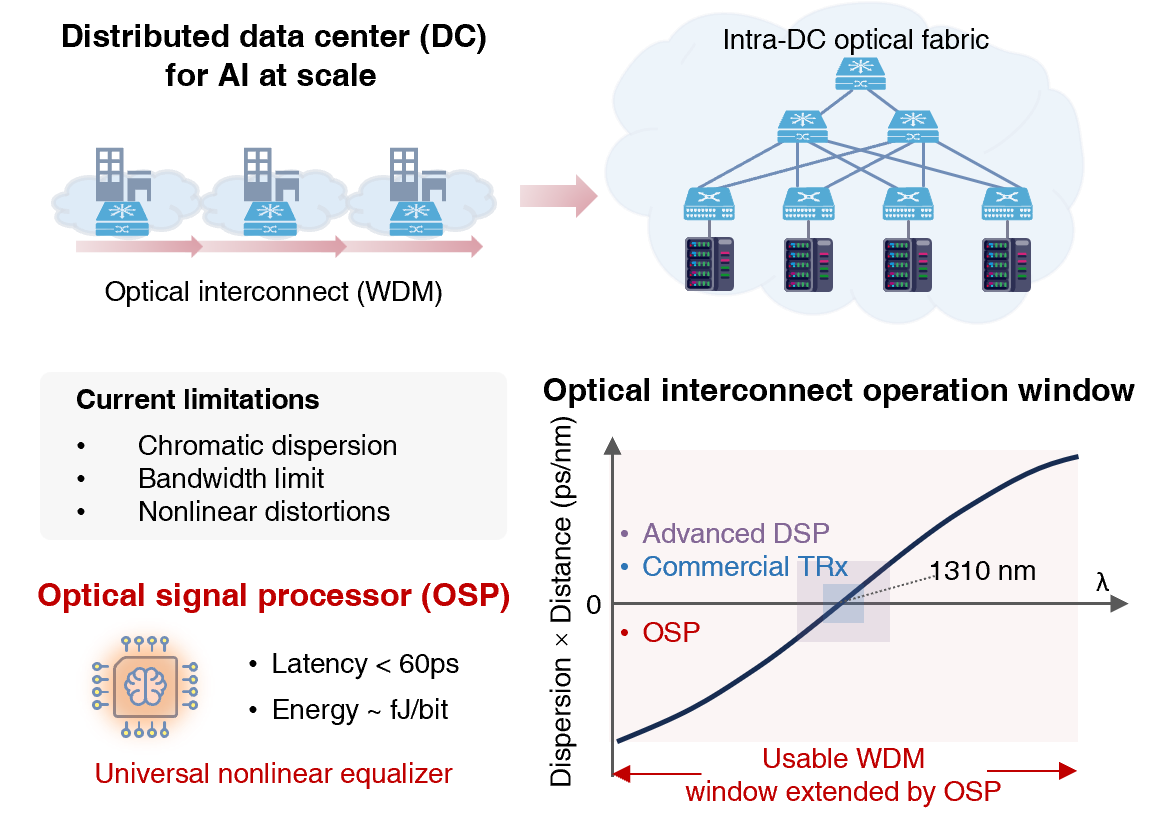
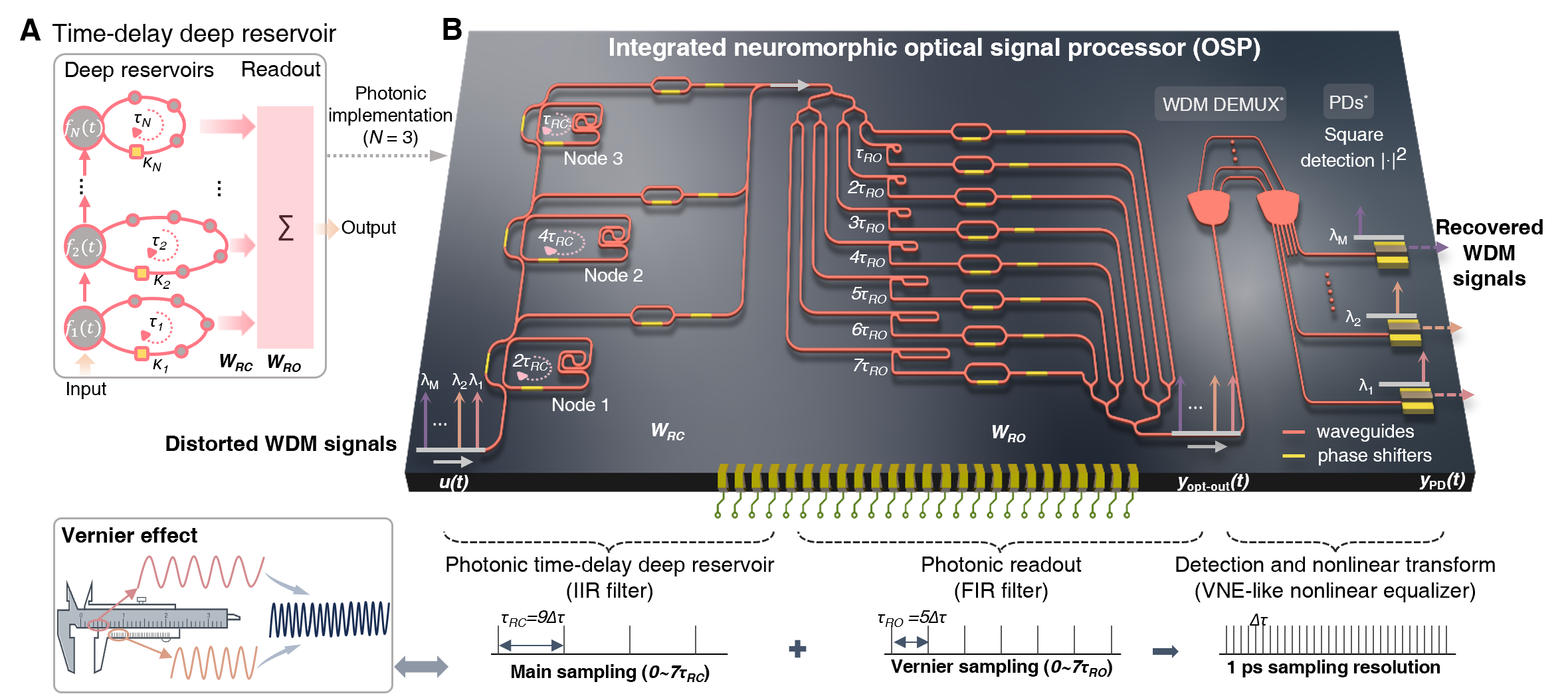
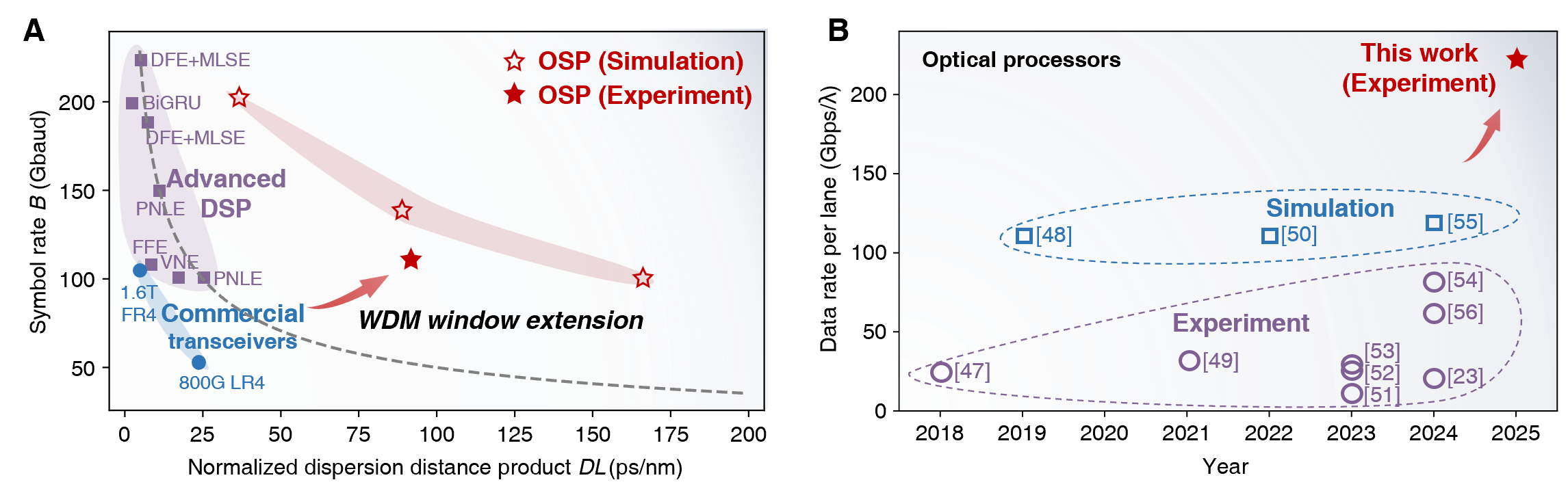
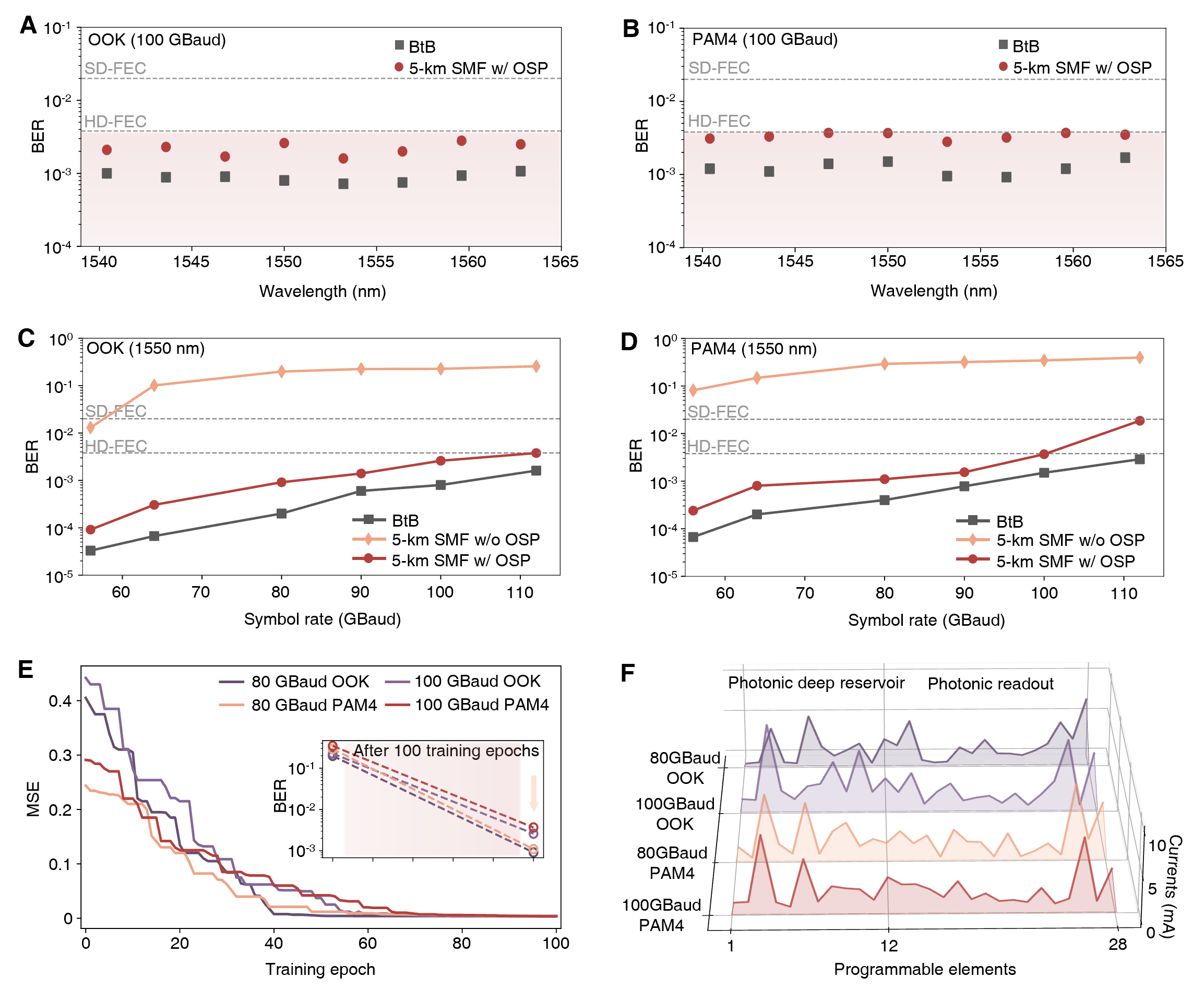
A research team led by Professor Huang Chaoran from Department of Electronic Engineering has developed a novel integrated all-optical signal processor (OSP) to address the massive data transmission demands of next-generation AI systems, particularly for high-speed links between multiple data centres. Built on a silicon photonic chip, the OSP processes optical signals directly in the light domain, correcting distortions in real time without converting them into electrical signals. This approach significantly improves transmission speed, reduces latency and lowers energy consumption compared with conventional digital signal processing (DSP). Experimental results demonstrate that the OSP achieves an aggregate data rate of 1.6 Tb/s with latency below 60 picoseconds and energy consumption of only tens of femtojoules per bit. These results address key performance bottlenecks in current communication technologies and offer a promising solution for ultra‑low‑latency, energy‑efficient AI computing. The findings have recently been published in the leading international academic journal Science. Rapid AI growth drives demand for high-speed transmission across large-scale distributed data centres As AI systems increasingly rely on distributed computing across multiple data centres, fast and reliable data exchange has become critical. However, conventional electronic signal processing struggles to keep up with rising transmission speeds and associated signal distortions. “Optical fibre communications form the backbone of modern data transmission and data centre interconnect technologies. However, conventional data centre interconnect technologies are increasingly struggling to keep pace with the scale and speed required by modern AI systems,” said Professor Huang Chaoran, Assistant Professor in the Department of Electronic Engineering, CUHK. “As transmission rates continue to rise, signal distortion becomes more severe, and if signal processing still relies on electronic methods, it can also introduce severe latency and significant power consumption.” Correcting distorted signals directly with light for greater efficiency To address these challenges, Professor Huang’s team, together with researchers from Huazhong University of Science and Technology (HUST) and Fudan University (FDU), has developed the programmable OSP, which can flexibly compensate for various signal impairments, including chromatic dispersion and nonlinear distortions. Its design draws inspiration from neuromorphic computing and machine learning, enabling more accurate signal correction. The OSP also demonstrates strong scalability and adaptability across different transmission conditions, wavelengths and data formats, and has the potential to significantly expand optical fibre capacity. This research marks an important step forward in optical communication, highlighting a future where light is used not only to transmit but also to process information, advancing next‑generation communication and computing technologies.
More information about the research: Professor Huang Chaoran is the corresponding author. Other contributing authors of this work include Wang Benshan (first author), Xiao Qiarong (co-first author), Xu Tengji, Fan Li and Liu Shaojie from CUHK; and collaborators (Professor Kong Qiuqiang from CUHK, Professor Dong Jianji from HUST, and Professor Zhang Junwen from FDU). The full text can be found at https://www.science.org/doi/10.1126/science.ady5344. |
|